

Welcome!

There is a Victorian road I can always find,
even in a strange land.
--Emily Isaacson
A Quiet Place for Sacred Breath
Welcome to my scattered anthem. My name is Emily Isaacson, and I am a poet who lives by candlelight—both literally and inwardly. I write from a life shaped by devotion rather than spectacle, by attention rather than noise. My work grows slowly, like prayer, and often in quiet places: near forests, near convents, near the steady rhythms of contemplation. Poetry, for me, is not performance. It is a form of listening, a way of keeping watch, a way of tending what is sacred when the world moves too quickly to notice.
My first collection, The Fleur-de-lis, was published in 2011, though it was written under far more difficult circumstances. During a period of confinement and profound inward turning, I wrote over eight hundred poems in English and French—many of them addressed not to audiences, but to recluses, monks, ministers, and unseen readers. Critics later called the work mystical, even magical, likening it to a royal bouquet that crossed borders and languages. For me, it was an act of survival and offering: poetry as breath, poetry as witness, poetry as a small flame kept alive.

Since then, my writing has continued to follow a similar path—one rooted in classical forms, sacred music, and ancient devotion. My books draw on requiems, da capo arias, oratorios, and sonnets not as ornament, but as spiritual architecture. These forms allow me to hold grief, endurance, and hope together. I have always believed that beauty does not need spectacle to be powerful; it needs structure, patience, and faithfulness. My poems are often described as speeches or prayers, meant to be entered slowly like a massive cathedral, not consumed.
I live and write in the rural, forested Fraser Valley of British Columbia, near the Poor Clares, whose friendship and way of life have deeply shaped my understanding of silence, labour, and sacred time. My days are simple. I light candles. I walk. I listen. I write. This rhythm is not an escape from the world, but a way of staying present to it. Much of my work stands at the threshold between the Old World and the New—between Europe’s devotional inheritance and Canada’s quiet, interior landscapes.
If you are here, I invite you to enter slowly into the sanctity I know as poet. You do not need to understand everything at once. These poems are not meant to impress, but to accompany—to sit with you, to keep vigil, to offer light where it is needed. My hope is that, somewhere in these pages, you will find a candle you can carry with you: a small flame of attention, endurance, and grace.
New Title: The Humming by Emily Isaacson

Letters to Lilith . . . for the Flowering Month of May
Between Bear Mountain and Jerusalem, between rain-soaked cedar forests and olive branches turning silver before a storm, two women begin a correspondence that becomes far more than letters alone. Emily writes from the Fraser Valley in British Columbia—by candlelight. Lilith answers from stone courtyards and desert thresholds where peacocks wander through fig-shadow and olive oil burns in clay lamps beneath darkening skies. Together, they move through questions of poetry and prophecy, asking what it means to remain fully human in a world that rewards distraction and fragmentation. Beneath every page runs the low continuous vibration they come to call the humming—the hidden resonance beneath the weather, memory, prayer, and the soul itself.
Written in luminous prose that moves between the contemplative, the philosophical, and the deeply intimate, The Humming is a literary meditation on rootedness, artistic vocation, and the sacredness hidden within ordinary life. Candles carried through quiet rooms. Rain moving through cedar roots. Cathedral windows igniting at sunset. Olive trees enduring difficult ground long enough to become oil and light. As the correspondence deepens, Emily and Lilith discover that revelation is not spectacle, power, or escape from the world, but a form of listening sustained with enough patience that reality itself begins to speak. The Humming offers a haunting and unforgettable journey into the inward life and the enduring mystery that waits beneath all things.
143 pages Paperback E-book

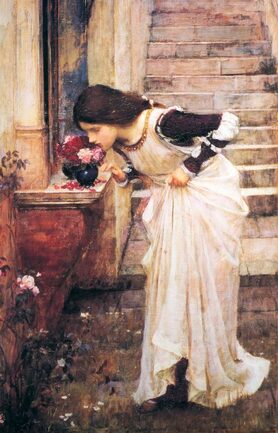
This is one of my favourite paintings by Waterhouse.
It is called The Shrine.
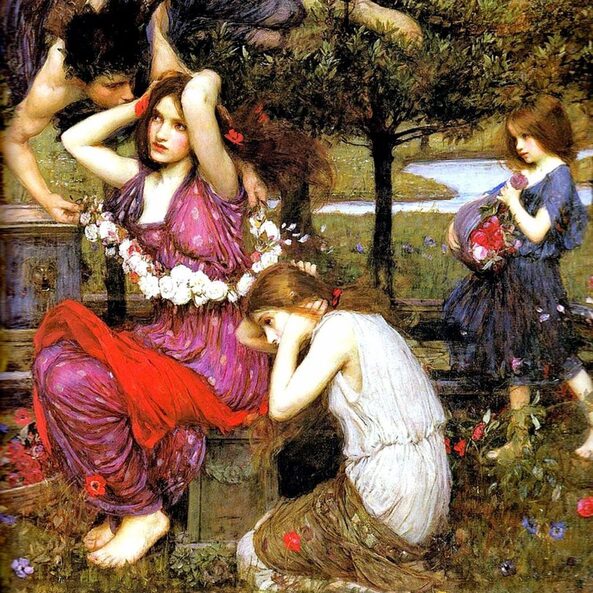
Painting by J.W. Waterhouse (1898) Image used by permission of the Hopkins Collection.
Storm Watcher by W.E. Isaacson

It’s an ambitious work that bridges tradition and modern sensibility.
—Jiminie Mochi, reviewer
I’d rate this book 5 out of 5 stars. . . Isaacson’s use of classical structures feels intentional rather than old-fashioned, and her spiritual undertones carry real weight. Readers who love poetry that feels lush, symbolic, and unapologetically emotional will find this collection rewarding.
—Shey Saints, reviewer
W.E. Isaacson’s Storm Watcher is a powerful return to form — a luminous and classically wrought collection of 85 new poems, steeped in the tradition of sonnet and song. Her voice, at once prophetic and intimate, draws from ancient sources and modern stirrings, evoking the wind-lashed beauty of coastal landscapes and the intricate symbolism of Pre-Raphaelite art. From Cleopatra’s court to the cloisters of contemporary Catholicism, Isaacson paints vivid scenes with poetic brushstrokes.
A lover of rhyme and rhythm, she crafts sonnet sequences that echo the musicality of the past while navigating the mysteries of the present. Her work offers readers the comfort of an old library, the spark of the Romantic imagination, and the stillness of a chapel on a rainy afternoon. With a touch of the mystic and the measured grace of a true woman poet, Storm Watcher leaves its mark as both a personal revelation and a work of enduring literary beauty.
261 pages Paperback Hardcover E-book
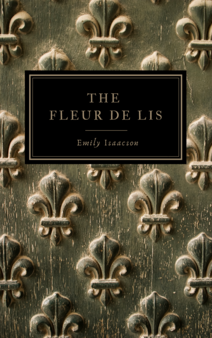
The Fleur-de-lis Republished

The Fleur-de-lis, a document by woman poet Emily Isaacson, was born from the confines of her imprisonment, producing over 800 poems in both English and French. Hailed as a mystic, her free-verse poetry astounded critics, earning her recognition as a distinguished figure in Canadian literature, with The Fleur-de-lis being likened to a royal bouquet that has traversed the borders to England.
Crafted for a prince, the collection now stands as a regal compilation in one volume, bearing the authentic words and personal seal of its enigmatic creator. Isaacson's poems, akin to mini speeches, manage to forge an intimate connection with readers. The fleur-de-lis, her enduring symbol, becomes a powerful metaphor for valour, standing resolute against the challenges she faced. The poems, whose recipients have been recluses, monks, and ministers, resonate in convents but face rejection in churches. The dichotomy of her gift, viewed by some as divine and others as witchcraft, only adds layers to the mystique surrounding Isaacson's work.
As history approached the conclusion of the Queen's era, the Royal Rose, Isaacson's poems transcended their temporal origins, becoming timeless expressions that would uplift and resonate with readers. Her legacy endures, casting her as the Queen of distant lands and closer hearts, leaving an indelible call through the corridors of time and offering a beacon of hope for next generations.
Paperback
Emily Quote . . .

I took up my favored pen,
and the meter of the salt roar,
the splendid gathering of stony shells
and aged driftwood
splashed off the pages
of the handmade paper, enameled
with rose blossoms and leaves,
for the retrieving of countries
almost lost
in the density of ocean,
for the salve of a wound time has marred.
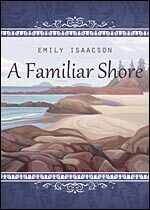
Emily Isaacson, A Familiar Shore